Learn About Powder Mixing Equipment, Modern Blending Methods, and Applications
Introduction Powder mixing equipment plays a vital role in modern manufacturing by helping businesses produce consistent, high-quality products across a wide range of industries. From pharmaceutical tablets and nutritional supplements to food ingredients, chemical compounds, cosmetics, and construction materials, many products begin as dry powders that must be blended accurately before moving to the next stage of production. Even slight variations in ingredient distribution can affect product quality, performance, or safety, making effective powder mixing an essential manufacturing process. Modern powder mixing equipment is designed to combine dry materials efficiently while preserving their physical properties. Unlike manual mixing, industrial blending systems offer greater consistency, improved productivity, reduced waste, and better process control. As manufacturing technologies continue to evolve, today's powder mixers also include automation, digital monitoring, energy-efficient designs, and hygienic features that support increasingly complex production requirements. This guide explains what powder mixing equipment is, how it works, common blending methods, equipment types, industrial applications, key features, benefits, limitations, current innovations, and practical tips for selecting and maintaining the right system.
What Is Powder Mixing Equipment?
Powder mixing equipment refers to machines that blend dry powders, granules, and similar materials into a homogeneous mixture. The objective is to distribute ingredients evenly throughout a batch while maintaining the desired physical and chemical characteristics of each component.
Depending on the industry, powder mixing equipment may process:
- Pharmaceutical ingredients
- Food powders
- Baking mixes
- Protein supplements
- Cosmetic powders
- Industrial chemicals
- Fertilizers
- Ceramic materials
- Cement additives
- Plastic compounds
These machines range from compact laboratory mixers to large industrial systems capable of processing several tons of material.
How Powder Mixing Equipment Works
Although different machines use different mechanisms, the overall process follows similar principles.
The typical workflow includes:
- Loading raw powdered ingredients into the mixing chamber.
- Selecting the required mixing program or operating settings.
- Activating the mixing mechanism.
- Blending materials for a specified duration.
- Discharging the finished mixture for packaging or additional processing.
Mixing may occur through tumbling, rotating blades, ribbons, paddles, screws, or fluidized motion, depending on the machine design.
The goal is to produce a consistent blend while minimizing ingredient separation, dust generation, and material loss.
Benefits of Powder Mixing Equipment
Modern mixing systems offer numerous operational advantages.
Consistent Product Quality
Uniform mixing ensures every batch contains evenly distributed ingredients, improving product consistency.
Higher Production Efficiency
Automated equipment can process larger volumes more quickly than manual methods.
Reduced Material Waste
Accurate mixing helps minimize product loss and improves raw material utilization.
Improved Process Control
Digital controls allow operators to repeat validated production settings across multiple batches.
Enhanced Workplace Safety
Enclosed systems reduce dust exposure while minimizing manual material handling.
Flexible Production
Many mixers can process different formulations with only minor setup adjustments.
Limitations of Powder Mixing Equipment
While highly beneficial, powder mixers also have certain limitations.
- Industrial systems can require significant investment.
- Different powders often require different mixer designs.
- Cleaning may take time between product changes.
- Sticky or moisture-sensitive materials may require specialized equipment.
- Routine maintenance is necessary to maintain performance.
- Improper equipment selection can reduce mixing efficiency.
Types of Powder Mixing Equipment
Selecting the appropriate mixer depends on production requirements and material characteristics.
Ribbon Blenders
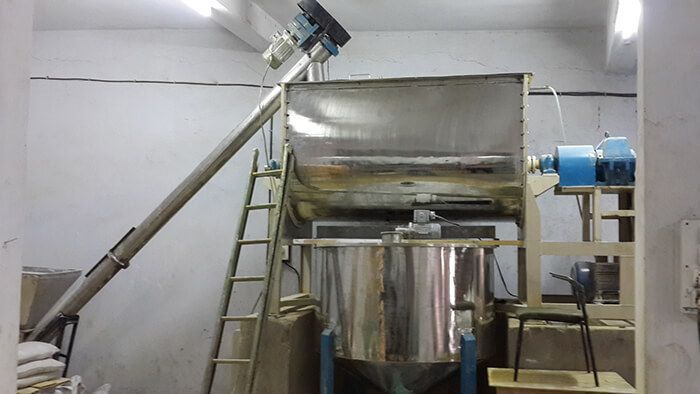
Ribbon blenders use inner and outer helical ribbons that move powders in opposite directions to create uniform mixing.
Common applications include:
- Food ingredients
- Animal feed
- Chemical powders
- Construction materials
Advantages include:
- Fast mixing
- High capacity
- Reliable blending performance
Paddle Mixers
Paddle mixers use rotating paddles to gently blend powders without excessive particle damage.
Often used for:
- Fragile materials
- Nutritional products
- Food processing
- Agricultural products
V-Blenders
A V-shaped vessel rotates continuously, allowing powders to tumble naturally.
Suitable for:
- Pharmaceutical manufacturing
- Nutritional supplements
- Laboratory production
Benefits include:
- Gentle mixing
- Minimal particle degradation
- Easy cleaning
Double Cone Blenders
Double cone blenders rotate powders within a cone-shaped vessel to achieve uniform mixing.
Typical applications include:
- Fine chemicals
- Pharmaceutical powders
- Food ingredients
Ploughshare Mixers
Ploughshare mixers use specially designed blades to create intense material movement.
Common industries include:
- Chemical manufacturing
- Mineral processing
- Powder coatings
Drum Blenders
Drum blenders rotate enclosed containers to blend powders through tumbling action.
Suitable for:
- Bulk powders
- Granular products
- Medium-volume production
Continuous Mixers
Unlike batch mixers, continuous systems blend materials continuously as they flow through the equipment.
Ideal for:
- High-volume manufacturing
- Automated production lines
- Continuous processing operations
Comparison of Powder Mixing Equipment
| Equipment Type | Mixing Method | Best Applications | Advantages |
|---|---|---|---|
| Ribbon Blender | Ribbon agitation | Food, chemicals | Fast, versatile |
| Paddle Mixer | Paddle movement | Fragile materials | Gentle blending |
| V-Blender | Tumbling | Pharmaceuticals | Uniform mixing |
| Double Cone Blender | Rotating vessel | Fine powders | Easy cleaning |
| Ploughshare Mixer | High-intensity mixing | Industrial powders | Excellent dispersion |
| Drum Blender | Rotating drum | Bulk materials | Simple operation |
| Continuous Mixer | Continuous processing | Large-scale manufacturing | High productivity |
Modern Powder Blending Methods
Advances in manufacturing have introduced several effective blending techniques.
Batch Blending
Materials are blended individually before being discharged.
Advantages include:
- Flexible production
- Easier recipe changes
- Suitable for multiple product lines
Continuous Blending
Ingredients enter and leave the mixer continuously.
Benefits include:
- Higher productivity
- Reduced downtime
- Consistent output
High-Shear Mixing
High-speed mixing tools break apart agglomerates and disperse ingredients rapidly.
Common applications include:
- Specialty chemicals
- Pharmaceutical formulations
- Advanced material processing
Low-Shear Blending
Gentle mixing protects delicate particles while maintaining product integrity.
Suitable for:
- Food ingredients
- Nutritional powders
- Sensitive pharmaceutical materials
Vacuum Mixing
Air is removed during blending to reduce oxidation and improve product quality.
Frequently used for:
- Cosmetic products
- Pharmaceutical ingredients
- Specialty chemicals
Applications Across Industries
Pharmaceutical Industry
Powder mixing equipment is used for:
- Tablet formulations
- Capsule blends
- Active pharmaceutical ingredients
- Medical powders
Food Processing
Manufacturers blend:
- Baking ingredients
- Beverage powders
- Protein supplements
- Spice mixtures
- Dairy products
Chemical Industry
Applications include:
- Industrial additives
- Cleaning products
- Fertilizer formulations
- Pigments
Cosmetics
Manufacturers prepare:
- Face powders
- Cosmetic pigments
- Skin care powders
- Personal care products
Agriculture
Powder mixers help produce:
- Animal feed
- Fertilizer blends
- Crop nutrition products
Construction Materials
Construction manufacturers blend:
- Cement additives
- Dry mortar
- Tile adhesives
- Wall finishing compounds
Key Features to Consider
Selecting powder mixing equipment involves evaluating several important factors.
Mixing Capacity
The machine should support current production requirements while allowing future growth.
Material Compatibility
Equipment should be suitable for the physical characteristics of your materials.
Mixing Uniformity
Consistent ingredient distribution is critical for maintaining product quality.
Construction Material
Stainless steel is commonly preferred because it offers durability, corrosion resistance, and hygienic operation.
Cleaning and Maintenance
Easy-to-clean equipment reduces downtime and supports product quality.
Automation Features
Modern systems may include:
- PLC controls
- Touchscreen displays
- Automated recipes
- Batch monitoring
- Data logging
Safety Systems
Important safety features include:
- Emergency stop controls
- Safety interlocks
- Dust containment
- Overload protection
Energy Efficiency
Efficient motors and optimized mixer designs help reduce operating costs.
Latest Trends and Innovations
Powder mixing technology continues to evolve with advances in manufacturing.
Smart Manufacturing
Connected equipment allows operators to monitor production remotely.
Industry 4.0 Integration
Production data can be collected for quality control and process optimization.
Predictive Maintenance
Sensors detect equipment wear before major failures occur.
Hygienic Equipment Design
Improved machine construction simplifies cleaning and reduces contamination risks.
Automated Recipe Management
Digital control systems store validated mixing parameters for repeatable production.
Energy-Efficient Equipment
Manufacturers continue developing systems that reduce energy consumption without sacrificing productivity.
Modular Equipment Designs
Flexible systems allow manufacturers to expand production capacity more easily.
Leading Powder Mixing Equipment Manufacturers
Several manufacturers are recognized for industrial mixing technology.
| Company | Primary Focus | Typical Industries |
|---|---|---|
| Hosokawa Micron | Powder processing equipment | Pharmaceutical, chemicals |
| GEA | Food and pharmaceutical systems | Food processing |
| amixon | Precision powder mixers | Pharmaceutical, food |
| Munson Machinery | Industrial mixing equipment | Chemicals, food |
| PerMix | Powder and liquid mixers | Industrial manufacturing |
| Winkworth Machinery | Ribbon and paddle mixers | Food, chemicals |
| Bachiller | Industrial blending systems | Chemical processing |
| Charles Ross & Son Company | Mixing equipment | Cosmetics, chemicals |
When comparing suppliers, consider:
- Product range
- Mixing technologies
- Automation options
- Technical support
- Spare parts availability
- Maintenance requirements
How to Choose the Right Powder Mixing Equipment
Choosing the appropriate mixer starts with understanding your production requirements.
Define Your Materials
Evaluate:
- Particle size
- Bulk density
- Moisture content
- Flow characteristics
Determine Production Capacity
Select equipment that supports both current and future production needs.
Consider Product Quality Requirements
Applications requiring highly uniform blends may benefit from specialized mixer designs.
Evaluate Cleaning Requirements
Industries with frequent product changes should prioritize easy-to-clean equipment.
Compare Total Operating Costs
Consider:
- Energy consumption
- Maintenance expenses
- Cleaning time
- Spare parts
- Equipment lifespan
Powder Mixing Equipment Selection Checklist
Before purchasing equipment, review this checklist.
- Identify your product requirements.
- Determine production volume.
- Compare mixer technologies.
- Review material compatibility.
- Evaluate automation features.
- Consider cleaning requirements.
- Assess maintenance needs.
- Compare energy efficiency.
- Verify safety features.
- Research manufacturer support.
Tips for Best Use and Maintenance
Proper maintenance helps improve equipment reliability and extend service life.
Clean Equipment After Each Batch
Remove remaining materials to reduce contamination.
Avoid Overloading
Operate within the manufacturer's recommended capacity.
Inspect Mechanical Components
Regularly check ribbons, paddles, bearings, seals, and drive systems.
Lubricate Moving Parts
Follow the maintenance schedule provided by the equipment manufacturer.
Monitor Mixing Time
Validated mixing times help maintain product consistency.
Replace Worn Components
Timely replacement minimizes downtime and protects product quality.
Train Equipment Operators
Well-trained operators help improve safety, efficiency, and production consistency.
Frequently Asked Questions
What is powder mixing equipment?
Powder mixing equipment consists of machines designed to blend dry powders and granular materials into uniform mixtures for manufacturing applications.
Which industries use powder mixing equipment?
Common industries include pharmaceuticals, food processing, chemical manufacturing, cosmetics, agriculture, ceramics, and construction materials.
What is the difference between batch and continuous blending?
Batch blending processes one batch at a time, while continuous blending provides an uninterrupted flow of materials for large-scale production.
Which mixer is commonly used for pharmaceutical powders?
V-blenders and double cone blenders are widely used because they provide gentle, consistent blending with minimal particle damage.
Why is uniform powder mixing important?
Uniform mixing helps ensure consistent ingredient distribution, reliable product quality, and predictable manufacturing performance.
How often should powder mixing equipment be maintained?
Maintenance schedules depend on equipment usage and manufacturer recommendations, but routine cleaning, inspections, lubrication, and replacement of worn parts help maintain reliable operation.
Can one mixer process different products?
Many industrial mixers can handle multiple formulations, provided they are compatible with the equipment design and proper cleaning procedures are followed between production runs.
Conclusion
Powder mixing equipment is an essential part of modern manufacturing, helping industries produce consistent, high-quality products efficiently and reliably. Whether used in pharmaceuticals, food processing, chemicals, cosmetics, agriculture, or construction, these systems support accurate ingredient distribution, improved process control, and greater production efficiency.
Understanding the different types of powder mixers, modern blending methods, equipment features, and maintenance requirements allows manufacturers to select solutions that match their operational goals. As automation, smart manufacturing technologies, and hygienic equipment designs continue to evolve, powder mixing systems are becoming increasingly capable of meeting changing production demands while supporting quality, efficiency, and long-term operational performance. Careful planning, proper equipment selection, and regular maintenance remain the foundation of successful powder blending operations.